Canada's foodservice workforce is one of the most linguistically diverse in the world. In kitchens across Toronto, Vancouver, Calgary, and Montreal, employees arrive speaking English, French, Punjabi, Arabic, Mandarin, Cantonese, Tagalog, Spanish, and dozens of other languages.
This diversity is a strength. It reflects the communities' restaurants serve and the talent organizations attract. But it creates a real challenge for food safety training: how do you ensure every employee learns the same material, to the same standard, regardless of the language they think in?
The Problem With Translated Exams
Many training providers advertise "multilingual options." Often, what that means is a single course in English, followed by an exam translated into other languages.
This approach has a fundamental flaw. A translated exam measures whether someone can read food safety questions in a second language. It does not measure whether they understood the material in the first place.
An employee who studied in English and tests in Punjabi is being tested on translation ability, not food safety knowledge. They may know the correct answer but struggle with the phrasing. Or they may understand the question but lack the vocabulary to connect it to what they learned.
The result is a false picture. Some employees who understand the material fail. Others pass without truly grasping the concepts. Neither outcome serves the business or the public.
Full Course Delivery Changes the Equation
When the entire course is available in a learner's language, the dynamic shifts completely. Lessons, scenarios, visuals, and the exam all live in the same language. The employee studies, practices, and tests in the language they understand best.
This means:
- Comprehension is genuine, not dependent on translation skills
- Scenario-based learning reinforces concepts through realistic images and situations, so understanding does not rely solely on text
- Pass rates reflect actual knowledge, not language barriers
- Employees retain what they learned because it was never filtered through a second language
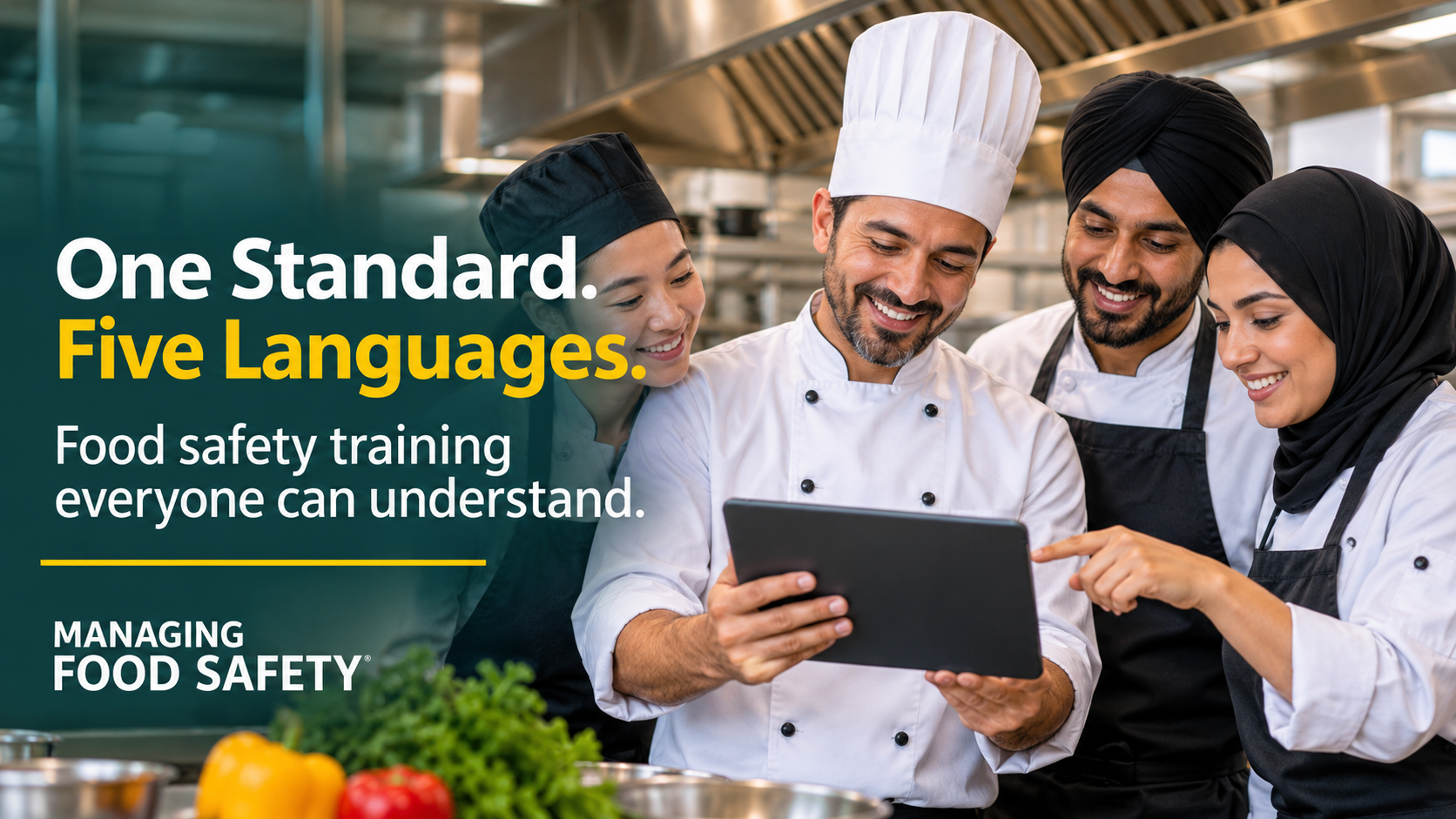
Managing Food Safety delivers the complete course in five languages: English, French, Arabic, Punjabi, and Simplified Chinese. Every lesson, every scenario, every exam question lives in the learner's chosen language. Visual scenario-based learning reinforces understanding across all versions, so a learner in any language identifies hazards in realistic kitchen images and connects them to proper procedures.
The Operational Side
Multilingual content alone is not enough. Large organizations need training to work within their existing systems.
Managing Food Safety is delivered as a format that is compatible with your business learning platform - compliant packages that install directly into an organization's learning management system. Employees launch the course from the platform they already use. Completion records land in the organization's own reporting environment.
This means:
- No separate vendor portal for managers to log into
- No exporting data from one system and importing it into another
- No reconciliation between two databases of employee training
- Training records live alongside every other training the organization tracks
For organizations managing hundreds or thousands of employees across multiple locations, this simplicity matters. The training system already holds the answer to "is this person certified?" No extra step required.
National Recognition, Local Accessibility
The Managing Food Safety certificate is recognized in every Canadian province and territory that requires food handler training. Organizations can offer training in five languages while maintaining a single, nationally recognized certification standard.
There is no trade-off between accessibility and credibility. Both are delivered at the same time.
What This Means for Your Team
If your workforce speaks multiple languages, your training program should meet them where they are. Not with a translated test bolted onto an English course, but with a complete learning experience in the language they think in.
The result is better-trained employees, cleaner records, and a compliance program that works the way your operations actually run.
To learn more about how Managing Food Safety supports multilingual, multi-location food safety training across Canada, explore our training solutions today.